
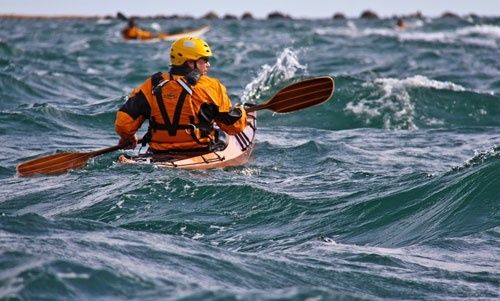
How to Turn Your Sea Kayak Smoothly in Choppy Coastal Waters
Why Choppy Waters Demand a New Paddling Mindset
The first move from a sheltered lake or calm inland bay to an exposed coastline can feel surprisingly demanding. The kayak rises and drops beneath you, the paddle blade sometimes lands in aerated water, and the bow may appear to wander whenever a gust hits. Many intermediate paddlers respond by tightening their grip, locking their knees and pulling harder. That reaction is understandable, but it usually makes turning less smooth and stability less reliable.
Before working on technique, make sure the trip matches your ability, equipment and conditions. A sea kayaking guide can help you assess suitable routes, safety equipment and preparation before committing to more exposed water. In practice, the most useful change is mental. Choppy water is not a flat surface that has become inconvenient. It is a moving environment with a rhythm, and your kayak needs to be allowed to respond to it.
Rigid, athletic bracing often fights that rhythm. When your shoulders rise and your arms become stiff, every small wave feels like a threat, and a turning stroke becomes a contest of strength. Smooth coastal turning is closer to fluid choreography. The lower body connects you to the boat, the torso supplies the rotation, and a gentle edge helps the hull follow the paddle. Once breathing settles and unnecessary tension disappears, confidence returns with it.
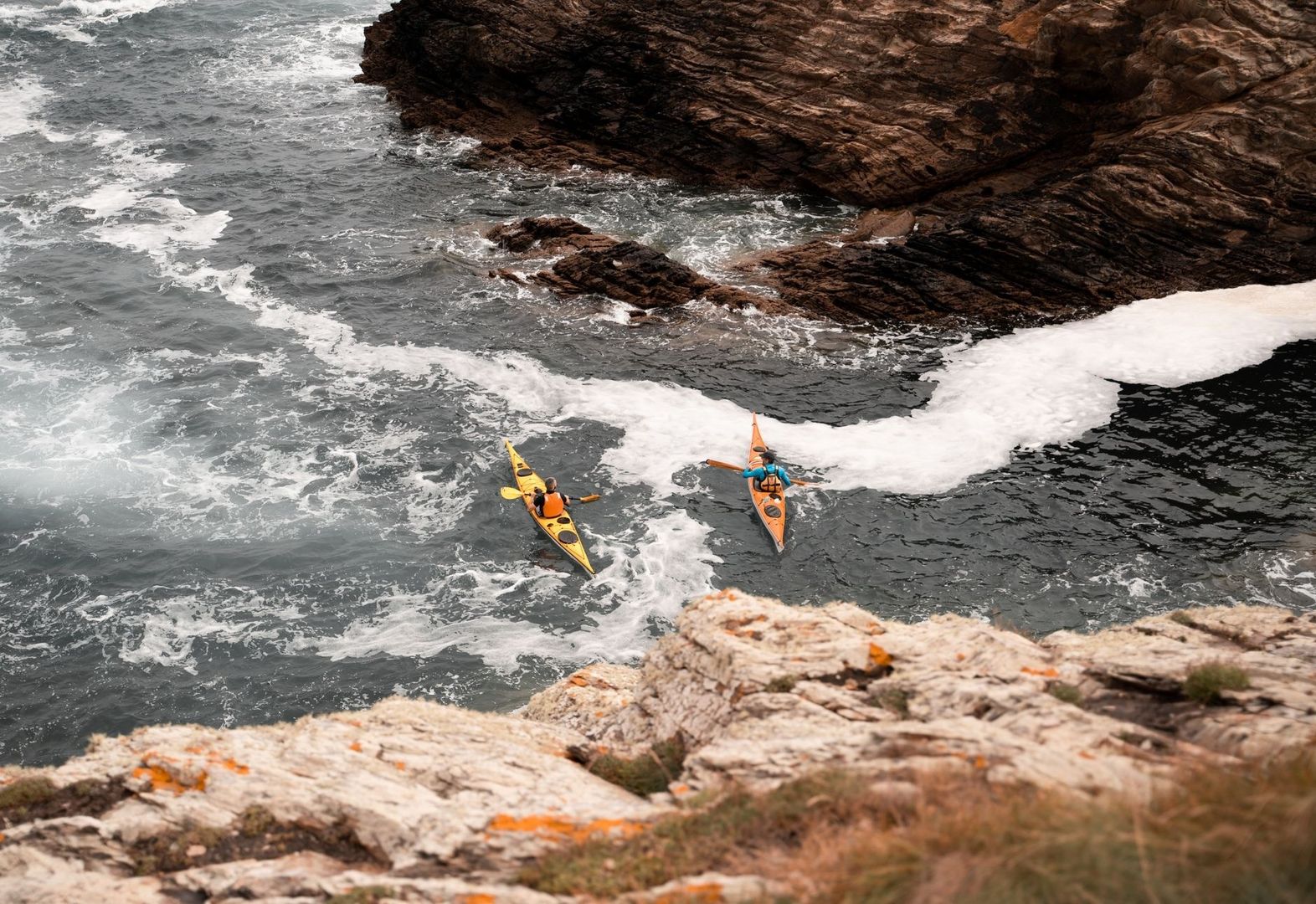
Finding Equilibrium Through Lower Body Connection
Your connection with the kayak begins below the waist. A correctly fitted cockpit allows the thighs, knees, hips and feet to provide information about how the hull is moving. This is proprioceptive feedback, the body”s awareness of position and movement through receptors in the muscles, joints and tendons, alongside information from the inner ear. Practical balance training guidance from the Tsunami Rangers also emphasises posture, smooth movement and rhythmic breathing as foundations for stability.
Thigh braces should give you a clear point of contact without forcing your knees into a permanent lock. In rougher water, the aim is responsive contact: the knees can press lightly against the deck while the hips remain mobile enough to absorb movement. A rigid leg lock transfers every wave directly into the torso and encourages you to brace with the arms. Relaxed knee contact, by contrast, lets you adjust the boat”s edge without losing the sense that the kayak is beneath you.
Cockpit designs offer different compromises. A standard keyhole cockpit can give strong edging and rolling leverage, while a more centrally positioned knee arrangement may support straighter leg alignment and forward-paddling form. High-knee designs attempt to combine these benefits, although they may alter windage, low-stroke clearance and wet-exit ease. The right setup depends on your body, technique and intended conditions, not on a single universal design.
- Check that your feet rest firmly against adjustable foot pegs or a bulkhead without forcing your ankles into an uncomfortable angle.
- Keep a light, even contact between both thighs and the braces, rather than clamping down with one knee.
- Confirm that you can rotate your hips and torso without the seat or cockpit rim restricting movement.
- Practise entering, exiting and wet-exiting the kayak before paddling in exposed coastal water.
- Make sure the spray deck fits securely, but does not create pressure that encourages you to sit rigidly.
Unlocking Torso Rotation to Eliminate Paddle Flutter
When the arms do most of the work, the paddle tends to flutter, stall or skid, particularly when the blade meets confused cross-chop. Arm-powered strokes also fatigue quickly. As the shoulders tire, the grip becomes tighter and the paddle blade loses a clean angle in the water. The result is a series of sudden corrections rather than one controlled turn.
Torso rotation gives the stroke a longer, steadier path. Rotate from the hips and trunk, allow the shoulders to follow, and keep the working arm relatively relaxed. The paddle blade should enter with purpose, remain supported by the water through the sweep, and exit before the stroke pulls your balance out of position. In aerated foam, do not expect the same solid resistance found in flat water. Maintain a connected movement instead of trying to overpower the unstable water.
| Flat-water arm stroke | Rough-water core-driven stroke |
|---|---|
| Power comes mainly from the shoulders and arms | Power begins with hip and torso rotation |
| Blade pressure is relatively predictable | Pressure changes as the blade moves through foam and chop |
| Long, forceful strokes may be comfortable | Shorter, well-timed strokes often maintain better control |
| The kayak sits on a more stable surface | The lower body must stay responsive to hull movement |
| Turning can be treated as a mechanical action | Turning depends on timing, edge and awareness of wave rhythm |
Think of the torso as the engine and the arms as the link between the engine and paddle. The arms position the blade, but they should not carry the whole load. Keep the shoulders below the ears, breathe out during the power phase and allow the non-working hand to move smoothly across the body. This reduces paddle flutter and helps the blade remain planted even when the sea surface is broken.
Executing the Wide Sweep Turn Step by Step
Timing makes a major difference. Look across the water rather than directly at the bow. Steep chop often shows useful patterns, such as darker wind lines, smooth gaps between peaks or areas where wavelets are travelling in a consistent direction. You are not trying to wait for perfectly calm water, but you can choose a moment when the hull is less likely to be lifted sideways halfway through the turn.
A wide sweep stroke turns the kayak by placing the blade away from the hull and drawing it in a broad arc. The turn becomes smoother when the paddle, torso and kayak edge work together. Keep your shoulders aligned over the hull instead of leaning dramatically away from the stroke. Excessive upper-body lean can make the blade feel powerful for a moment, but it also reduces your ability to respond when a wave arrives from the side.
- Scan the surface and select a turning window between larger chop peaks. Keep your eyes on the direction you want to travel.
- Rotate your torso toward the side of the turn while keeping your hips connected and your knees softly engaged.
- Place the blade near the bow, away from the hull, with the shaft at a comfortable angle and the grip relaxed.
- Draw the blade in a wide arc towards the stern, allowing the torso to unwind rather than pulling only with the arms.
- Apply a gentle edge toward the outside of the turn. The edge should be subtle, not a dramatic tilt that threatens your balance.
- As the kayak reaches the new heading, lift the blade cleanly and recover without stopping the boat”s momentum.
The edge helps the hull carve, but it should be introduced gradually. If the kayak leans too far, release the edge, widen your base through the knees and use a low brace only if genuinely needed. A turn that preserves forward momentum is usually more stable than one that depends on several emergency strokes. Practise first in light wind and small chop, then increase exposure as your timing improves.
Working With Coastal Wind and Trim Instead of Fighting Them
Wind can make a turning problem appear to be a technique problem. When the stern is pushed away from the wind, the bow turns into it, a behaviour known as weathercocking. Short, steep chop magnifies this effect because each wave briefly lifts or slows part of the hull. The bow may feel reluctant to move downwind, while the kayak repeatedly tries to face into the gusts.
Small trim adjustments can restore control. Keep heavy equipment low and centred, avoid loading the stern or bow excessively, and use your foot position and posture to maintain a balanced waterline. If your kayak has a skeg, deploy it incrementally rather than dropping it fully at the first sign of wind. A skeg changes the balance between bow and stern and can reduce weathercocking without removing all turning ability. A discussion of adjustable skeg trim and rudder behaviour in changing conditions appears in this paddling equipment analysis.
- Check wind direction, gust strength, tide and return-route options before launching.
- Use a partial skeg setting to find a neutral balance rather than relying on maximum deployment.
- Keep your upper body quiet in crosswind and let the legs remain loose over the chop.
- Use shorter, more frequent strokes when a gust threatens to push the bow off line.
- Avoid committing to a downwind route that creates an exhausting or unsafe return journey.
There is also a useful mental adjustment. Instead of treating every wave as an interruption, notice how the sea is moving and allow that information to guide your timing. This does not mean ignoring risk. Forecasts, communication, buoyancy equipment, suitable clothing and conservative route choices remain essential. It means replacing anxious resistance with environmental awareness. That calmer attention can support outdoor wellbeing, reduce wasted effort and make each decision more deliberate.
Step Into Dynamic Waters With Fluid Confidence
Smooth turns in coastal chop come from coordination rather than brute force. A secure but relaxed lower-body connection, intuitive torso rotation, a wide sweep and a gentle edge allow the kayak to move with the water instead of being wrestled through it. Steady breathing is part of the technique because a breath held through every wave quickly becomes tension in the shoulders and hands.
Build this skill gradually in gentle breezes, on familiar shorelines and with competent paddling partners. Practise wide sweeps, edging and relaxed recovery strokes until they become automatic, then introduce slightly more movement and wind. With patience, the change from flat-water hesitation to dynamic coastal harmony becomes more than a technical improvement. It opens new routes, strengthens everyday confidence and creates a lasting paddling habit based on awareness, efficiency and respect for the sea.
Comments Comments: 0
Comments are closed.